

🔹 Introduction
The rise of electric tricycles (e-trikes) in Southeast Asia-especially in the Philippines and Vietnam-is reshaping local transportation. Compared with traditional gasoline-powered tricycles, 60V lithium batteries offer longer driving range, lower running costs, and stronger compliance with green energy policies.
In this article, we'll explore the technical specs, market suitability, performance vs. lead-acid batteries, and ROI analysis for 60V tricycle batteries, with a special focus on Philippines & Vietnam market recommendations.
🔹 Why 60V for Tricycles?
Most low-speed EVs, such as e-trikes and tuk-tuks, are built around 48V, 60V, or 72V systems. Among these, 60V strikes the balance:
- ⚡ Higher torque & climbing ability than 48V.
- ⚡ Lower cost & better safety than 72V.
- ⚡ Widely adopted in Southeast Asia, meaning parts, controllers, and chargers are easy to source.
👉 For urban passenger transport, a 60V 100Ah–150Ah LiFePO₄ battery is often ideal.
| Feature | Lead-Acid 60V 120Ah | LiFePO4 60V 100Ah |
| Cycle Life (times) | 400 | 5000 |
| Usable Energy (%) | 50 | 90 |
| Range per Charge (km) | 60 | 100 |
| Weight (kg) | 120 | 55 |
| 5-Year Replacement Cost Index | 100 | 40 |
🔹 Technical Specs of a Standard 60V LiFePO₄ Tricycle Battery
| Parameter | Typical Range | Notes |
|---|---|---|
| Nominal Voltage | 60V (16S or 19S LiFePO₄) | Stable output |
| Capacity Options | 80Ah / 100Ah / 120Ah / 150Ah | 100Ah most popular |
| Energy (kWh) | 6.0 kWh – 9.0 kWh | Matches daily driving demand |
| Cycle Life | 4000–6000 cycles (80% DoD) | 8–10 years lifespan |
| Weight | 45–70 kg | 50% lighter than lead-acid |
| BMS | 100–200A continuous | With overcharge, short-circuit, low-temp protection |
| Charging Time | 4–6 hours (standard charger) | 2–3 hours with fast charger |
| Compatible Loads | 1–3 passengers, light cargo | Market average load |
🔹 60V Battery vs. Lead-Acid in Tricycles
| Feature | Lead-Acid (60V 120Ah) | LiFePO₄ (60V 100Ah) |
|---|---|---|
| Weight | ~120 kg | ~55 kg |
| Cycle Life | 300–500 cycles | 4000–6000 cycles |
| Usable Energy | ~50% DoD = 3.6 kWh | ~90% DoD = 5.4 kWh |
| Charging Efficiency | ~70% | ~95% |
| Range per Charge | ~60 km | ~100 km |
| Cost over 5 Years | High (frequent replacement) | Lower (long lifespan) |
👉 A single 60V LiFePO₄ pack lasts 5–8x longer than lead-acid, while offering 40–60% more real-world driving range.
🔹 Market Fit: Philippines & Vietnam
📍 Philippines (E-Trike Program)
- Government-backed electrification of tricycles.
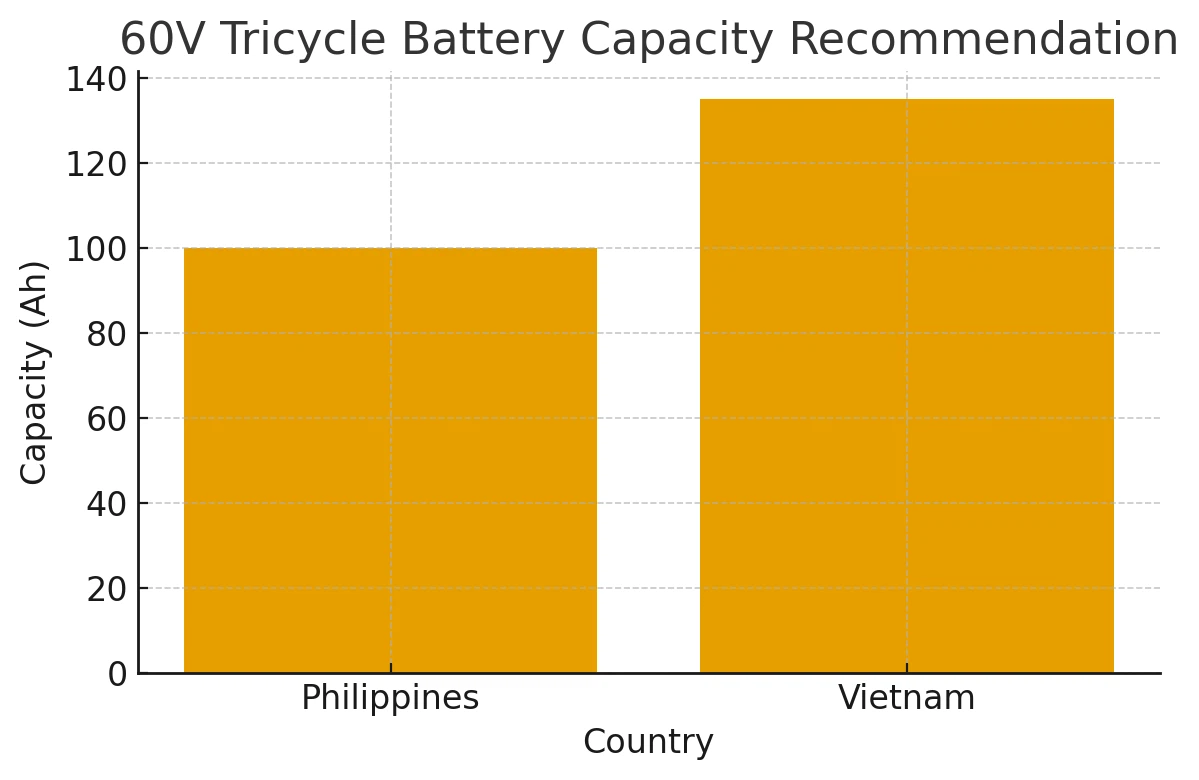
- Popular battery sizes: 60V 100Ah–120Ah.
- Target users: city commuters, short-distance passenger transport.
- Average daily mileage: 40–70 km → fits well with 60V 100Ah packs.
📍 Vietnam (Cargo & Passenger Tricycles)
- Strong demand in tourist transport + logistics.
- Preferred battery sizes: 60V 120Ah–150Ah.
- Target users: small businesses, local goods delivery.
- Average daily mileage: 60–100 km → requires larger packs.
👉 Philippines = 100Ah baseline, Vietnam = 120–150Ah recommended.
🔹 ROI Analysis (5-Year Cost of Ownership)
Scenario: E-trike running 60 km/day, 300 days/year = 18,000 km/year.
| Item | Lead-Acid 60V 120Ah | LiFePO₄ 60V 100Ah |
|---|---|---|
| Initial Cost | Low | 2–3x higher |
| Replacement Cycle | 1 year | 6–8 years |
| Total Replacements (5 yrs) | 5 | 1 |
| Avg. Energy Efficiency | 70% | 95% |
| Operating Cost (5 yrs) | High | Lower |
| Total 5-Year Cost | 100% baseline | ~40–50% of lead-acid |
👉 Despite a higher upfront cost, LiFePO₄ 60V saves 50–60% TCO in 5 years, while reducing downtime.

🔹 Charging & Maintenance Tips
- Use original or recommended chargers (avoid overcurrent).
- Keep SOC (state of charge) between 20%–90% for longer lifespan.
- Avoid storing below 0°C without heating function.
- For fleet users → implement scheduled battery rotation & health checks.
🔹 FAQ
Q1. Can I upgrade from 48V to 60V?
- Yes, but the motor controller and charger must match 60V.
Q2. What's the difference between 60V and 72V tricycle batteries?
- 72V offers higher speed & torque but costs more and requires heavier systems. 60V remains the best balance for urban transport.
Q3. Can 60V LiFePO₄ batteries be paralleled?
- Yes. Many fleets use 2 × 60V 100Ah in parallel for extended range.
🔹 Conclusion
The 60V tricycle battery is the sweet spot for Southeast Asian e-trikes, balancing speed, torque, safety, and cost-effectiveness.
Philippines → 60V 100Ah recommended.
Vietnam → 60V 120–150Ah better suited.
Long cycle life and ROI advantages make LiFePO₄ a must-have upgrade from lead-acid.
👉 Looking for reliable 60V LiFePO₄ tricycle batteries with customizable capacity? Check WHET Energy's Tricycle Battery Solutions