

Introduction: A Common Misunderstanding
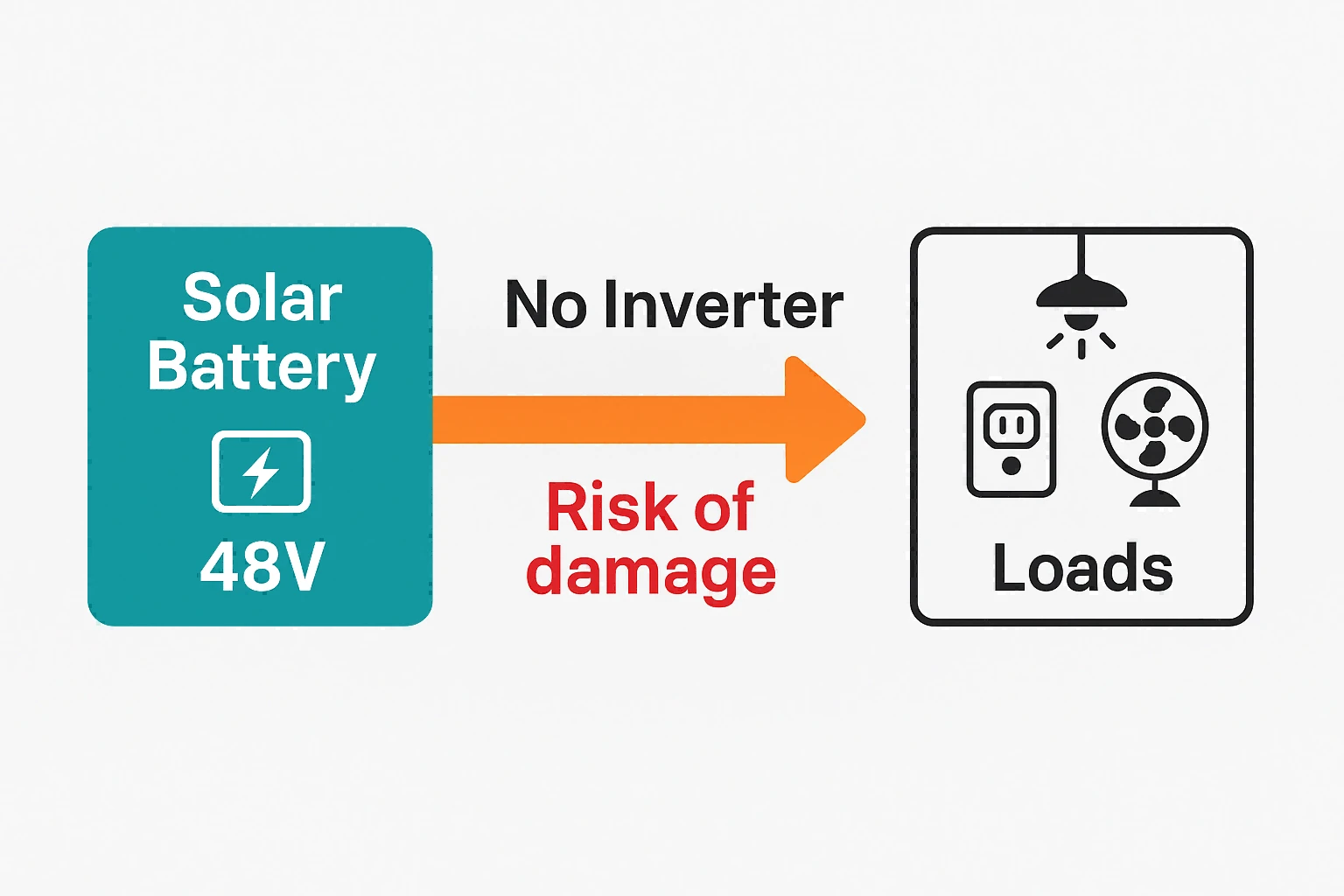
"Can I just buy a solar battery and use it without an inverter?"
We hear this question a lot from new users and buyers exploring energy storage. While the idea sounds simple, the reality is more complex. In most solar or off-grid power systems, an inverter is a necessary component to safely and effectively use your battery's stored energy.
This guide explains why an inverter is essential, what risks are involved in skipping it, and in which rare cases a battery-only system might be possible.
Why Solar Batteries Don't Work Alone
Solar batteries store energy in direct current (DC) form. However, most household or industrial appliances run on alternating current (AC). That's where the inverter comes in:
- DC → AC Conversion: The inverter converts the battery's DC output to usable AC power.
- System Protection: It also acts as the system brain-controlling voltage, current, and protection thresholds.
- Charging Management: The inverter regulates how the battery charges and discharges, especially in grid-connected or hybrid setups.
👉 Without an inverter, even if the battery is fully charged, you won't be able to power your AC devices.
What Happens If You Skip the Inverter?
If you try to connect solar panels directly to a battery-without an inverter or charge controller-here's what could go wrong:
- Overcharging Risk: Solar panel voltage can exceed safe limits for the battery, damaging the cells.
- No Load Management: Without an inverter, you can't manage discharge rates, leading to deep discharge or imbalance.
- No AC Output: You'll only get raw DC power, which can't be used for standard appliances.
- No Monitoring or BMS Communication: Advanced LiFePO4 batteries require a smart inverter to fully leverage their BMS.
In short: It's unsafe, inefficient, and likely to damage your battery or connected devices.
Are There Any Scenarios Where Batteries Work Without Inverters?
Yes-but very specific ones:
✅ 1. DC-Only Systems
Some systems are designed to operate purely on DC, such as:
- Low-voltage LED lighting setups
- Telecom base stations
- Remote camera installations
In these cases, the load is matched to the battery voltage (e.g., 12V, 24V, or 48V), and proper DC-DC converters or regulators are still required.
⚠️ Note: Even in DC-only setups, an MPPT solar charge controller is mandatory to safely regulate charging from the solar panels.
Why Inverters Are Essential for Home or Commercial Use
Unless you're designing a very niche DC-only system, you will need an inverter. Here's why:
| Function | Why It's Needed |
|---|---|
| Voltage Conversion | Converts DC from battery to usable 120V / 230V AC |
| Grid Interaction | Syncs battery with utility grid in hybrid systems |
| BMS Communication | Reads state-of-charge (SOC), temp, current from smart batteries |
| System Safety | Manages overload, overvoltage, short circuit protection |
| Energy Optimization | Controls charging time, grid export/import, time-of-use savings |
How to Choose the Right Inverter for Your Battery
If you're using a 48V or 51.2V LiFePO4 solar battery, you'll need an inverter that supports:
- CAN/RS485 communication protocols
- Customizable voltage & current parameters
- Matching charge/discharge logic
- Compatibility with your system's total load and application
👉 See our full guide: Top Inverters Compatible with 48V LiFePO4 Batteries (2025)
Conclusion: Always Use a Battery with a Proper Inverter
A solar battery alone cannot replace an inverter. The two are designed to work together as a system. Without the inverter, you lose the ability to safely convert, control, and optimize your energy use.
If you're planning a solar backup or off-grid project, ensure you select a battery and inverter that are fully compatible-and tested for communication, voltage, and reliability.
Need Help Matching Your Inverter and Battery?
At Whet Energy, we offer:
- 48V and 51.2V LiFePO4 battery packs
- Integrated PACE BMS with inverter protocols pre-configured
- Compatible inverter recommendations (Growatt, Victron, Deye, etc.)
📩 Contact us for a complete battery-inverter setup or OEM solutions.
#solarbattery #inverter #LiFePO4 #offgridpower #energystorage #DCpower #solarFAQ #whetenergy