

Hey there, fellow RV enthusiasts! I'm an RV battery supplier, and I get this question a lot: "How long can an RV battery power a microwave?" It's a great question, especially if you're planning a long - term camping trip or just want to enjoy a hot meal on the road without relying on shore power all the time.
First off, let's talk about the basics. There are two main types of RV batteries that you'll commonly see: 12V RV Battery and 24V RV Battery. The voltage of the battery plays a big role in how it can power your microwave.

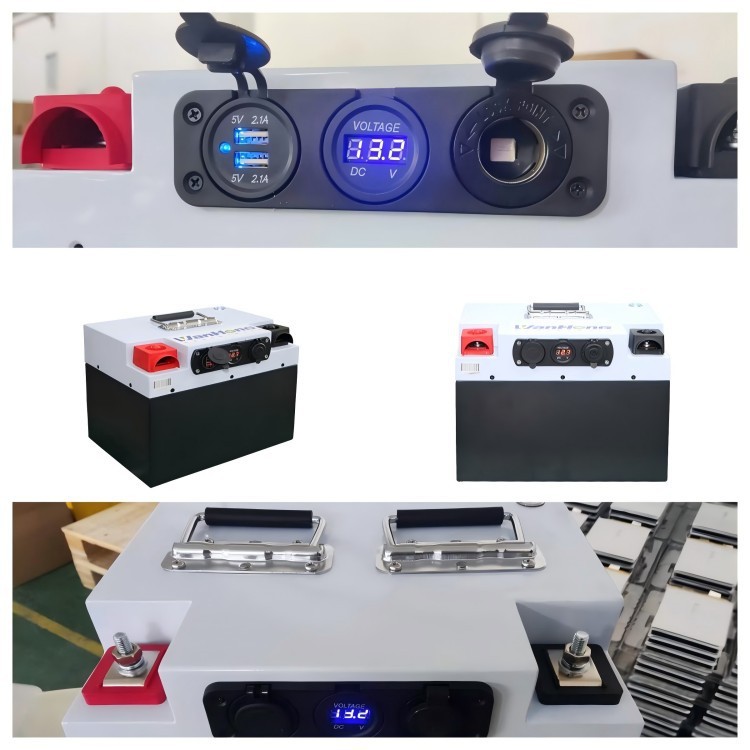
Understanding Battery Capacity and Microwave Power
Battery capacity is usually measured in amp - hours (Ah). This tells you how much current a battery can supply over a certain period. For example, a 100Ah battery can supply 1 amp of current for 100 hours, 2 amps for 50 hours, and so on.
On the other hand, microwaves are rated in watts. The power consumption of a microwave can vary widely. A small, portable microwave might use around 600 - 800 watts, while a larger, more powerful one could use 1000 - 1500 watts or even more.
To figure out how long a battery can power a microwave, we need to use a simple formula:
[ Time (hours)=\frac{Battery\ capacity (Ah)\times Battery\ voltage (V)}{Microwave\ power (W)} ]
Using a 12V RV Battery
Let's assume we have a 100Ah 12V RV Battery and a 800 - watt microwave.
First, we calculate the total energy stored in the battery. The energy (in watt - hours) is the product of the battery capacity and the battery voltage. So, for a 100Ah 12V battery, the energy is (100Ah\times12V = 1200Wh)
Now, we use the formula to find out the time.
[ Time=\frac{1200Wh}{800W}=1.5\ hours ]
That means a 100Ah 12V battery can power an 800 - watt microwave for about 1.5 hours. But there are a few things to keep in mind.
Batteries aren't 100% efficient. There are losses due to factors like internal resistance, and you shouldn't fully discharge a battery. Most deep - cycle RV batteries are recommended to be discharged to no more than 50% of their capacity to extend their lifespan. So, in reality, the actual usable time might be closer to 0.75 hours.
Using a 24V RV Battery
Now, let's consider a 24V battery. Suppose we have a 100Ah 24V RV Battery. The total energy stored in this battery is (100Ah\times24V = 2400Wh)
If we still use the 800 - watt microwave, the time it can power the microwave is:
[ Time=\frac{2400Wh}{800W}=3\ hours ]
Again, taking into account the 50% discharge limit, the actual usable time would be around 1.5 hours.
Other Factors Affecting Battery Life
- Battery Type: There are different types of RV batteries, such as lead - acid, AGM (Absorbent Glass Mat), and lithium - ion. Lithium - ion batteries are generally more efficient and can be discharged to a higher percentage of their capacity compared to lead - acid batteries. For example, a lithium - ion battery can often be discharged up to 80 - 90% without significant damage, which means you can get more usable time from them.
- Microwave Usage: The power consumption of a microwave can vary depending on how you use it. If you're using it at full power all the time, it will draw more energy. But if you're just using it for short bursts, like heating a cup of coffee, the overall energy consumption will be lower.
- Battery Age and Condition: As batteries age, their capacity decreases. A battery that's a few years old might not hold as much charge as it did when it was new. Also, if the battery has been damaged or not properly maintained, its performance will suffer.
Tips to Extend Battery Life for Microwave Use
- Opt for a Lower - Wattage Microwave: If you're planning to use your microwave on battery power, consider getting a lower - wattage model. A 600 - watt microwave will use less energy than a 1000 - watt one, which means your battery will last longer.
- Use an Inverter Wisely: An inverter is used to convert the DC power from the battery to AC power for the microwave. Make sure you have a high - quality inverter that's rated for the power of your microwave. A low - quality inverter can cause energy losses and reduce the overall efficiency.
- Charge Your Battery Regularly: If you're on a long trip, make sure to charge your battery whenever possible. You can use a solar panel, a generator, or hook up to shore power at a campsite.
Conclusion
So, as you can see, the time an RV battery can power a microwave depends on several factors, including the battery voltage, capacity, the power of the microwave, and other factors like battery type and usage. A 12V battery will generally power a microwave for a shorter time compared to a 24V battery of the same capacity.
If you're in the market for a new RV battery, whether it's a 12V RV Battery or a 24V RV Battery, we've got you covered. We offer high - quality batteries that are designed to meet the needs of RV owners. If you have any questions about which battery is right for you or how to get the most out of your battery, feel free to reach out. We're here to help you make the best decision for your RV adventures. Contact us today to start a discussion about your battery needs and let's find the perfect solution for you.
References
- "RV Batteries: A Complete Guide", RV Life Magazine
- "Understanding Battery Capacity and Power", Battery University